The Madonna della Coltura of Parabita: Seven Centuries of Devotion and Three Days of Celebration
Palazzetto Vico San Marco15 April 20269 min read
Share
The people of Parabita call her "la Matonna noscia" - our Madonna. That possessive says everything: this is not generic devotion, it is a bond of identity that this Salento village has nurtured for over seven centuries, passing it from generation to generation with the same intensity as a family name or a trade.
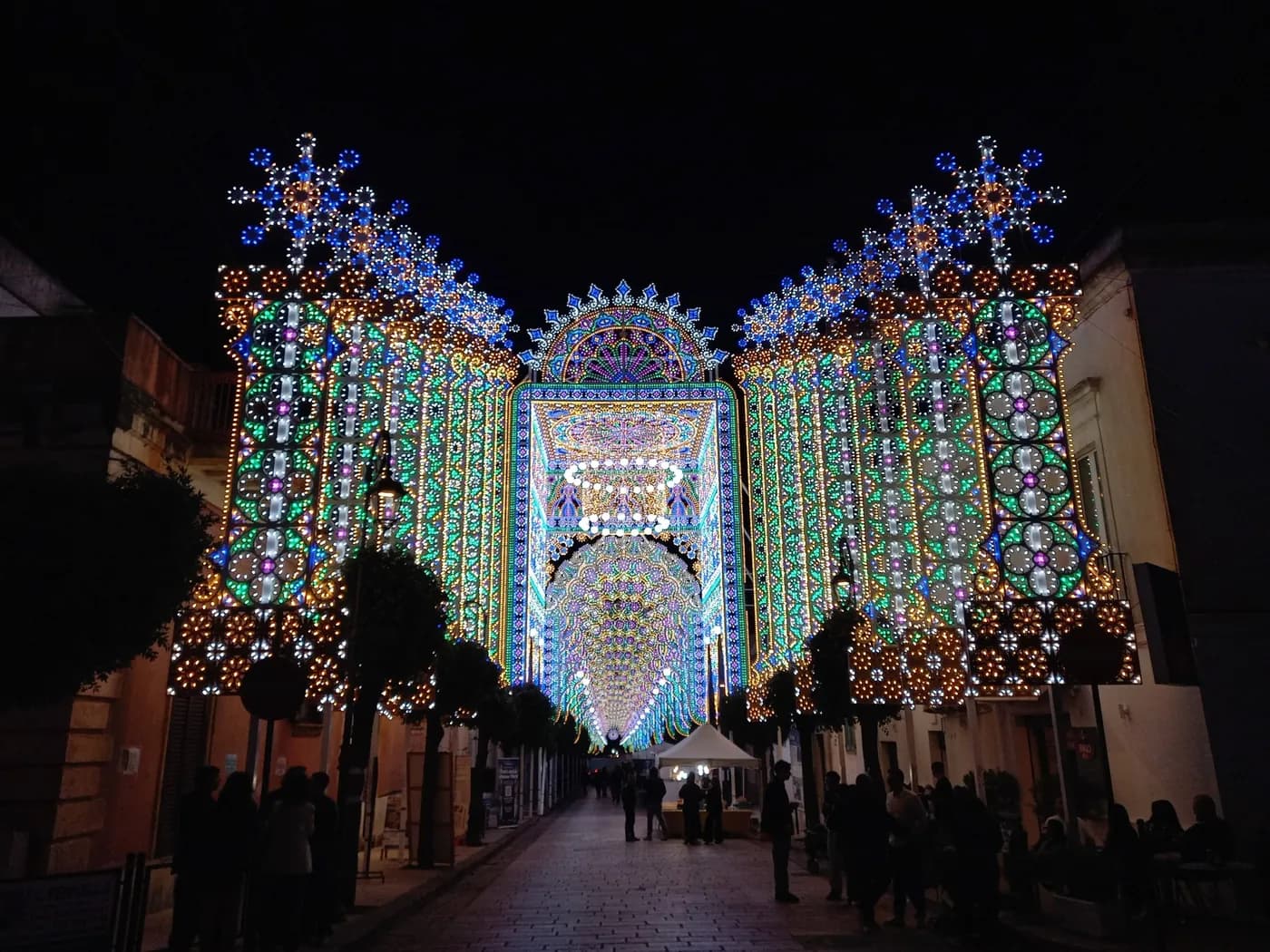
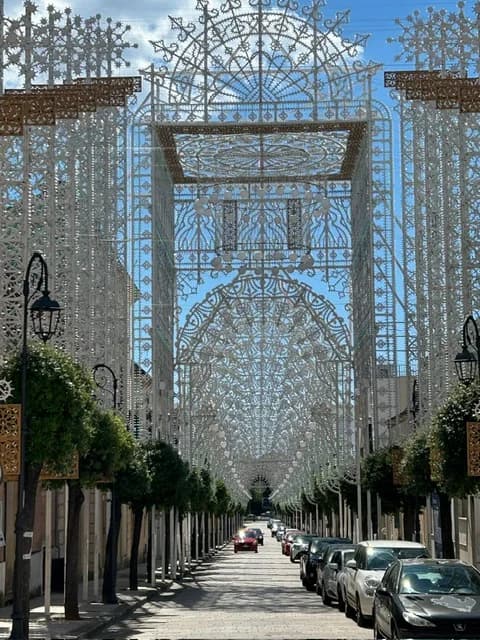
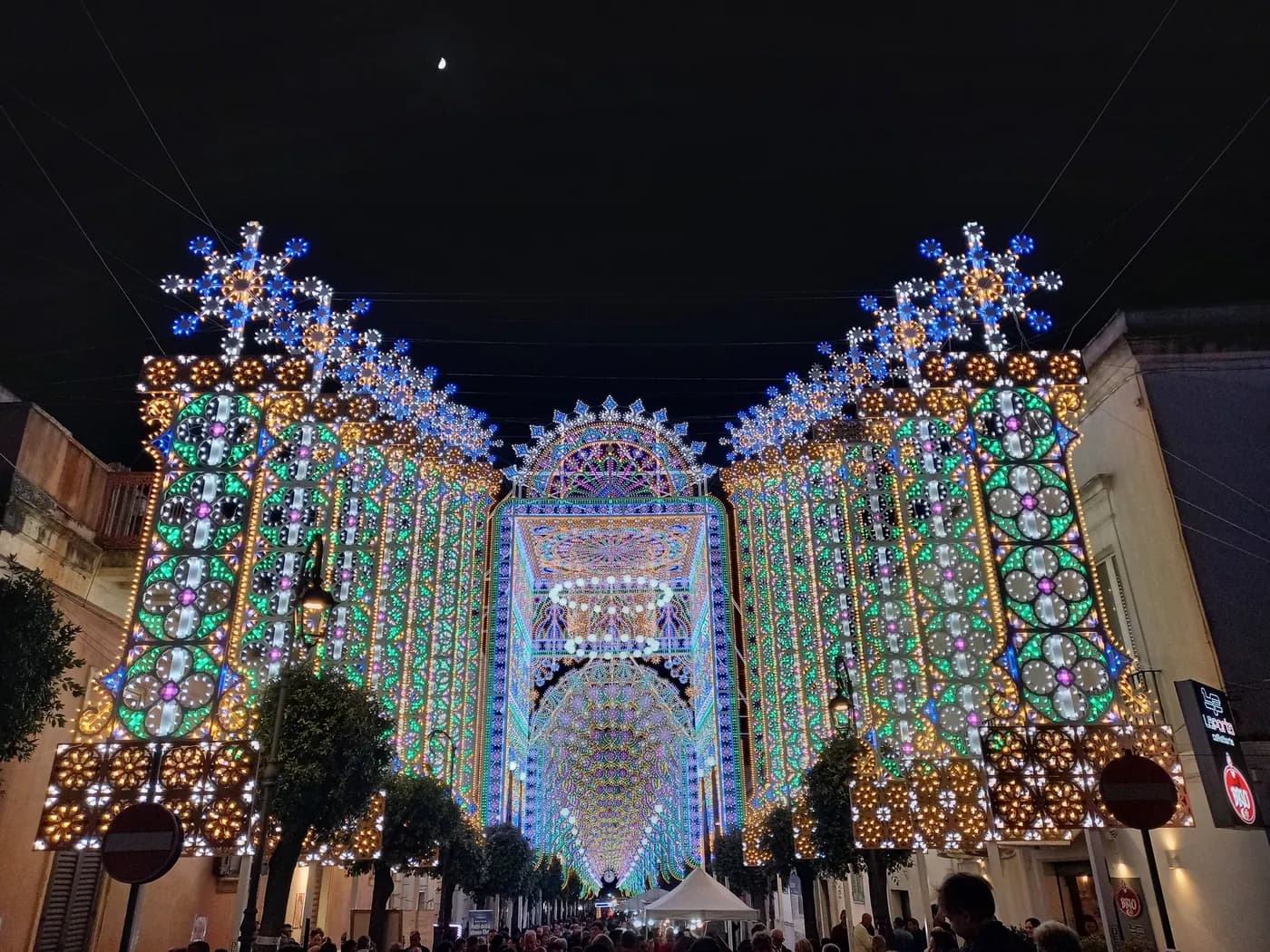
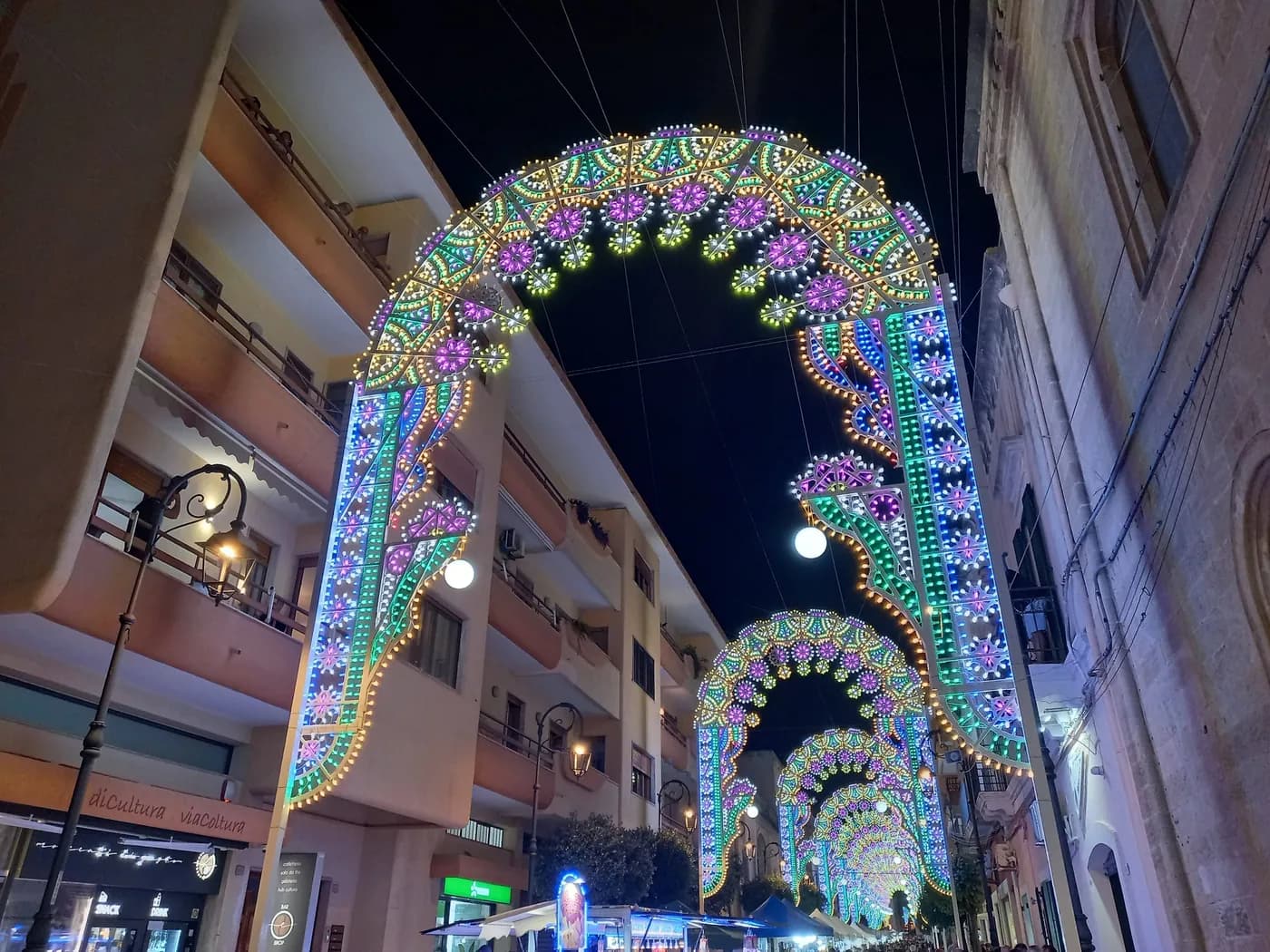
Every year, in the last week of May, Parabita is transformed. The streets of the historic centre fill with luminarie - elaborate illuminations stretching over two kilometres, with ornamental facades rising up to twenty-two metres high - brass bands arrive from across Puglia, and the sky blazes with fireworks and devotional hot-air balloons. In 2026 the celebrations take place on Saturday 24, Sunday 25 and Monday 26 May.
The entrance portal to the luminarie gallery in the historic centre of Parabita - the Madonna della Coltura festivities
But before the programme, there is a story to tell. Because to understand what happens during those three days, you first need to understand where all of this comes from.
The Origins: the Legend of the Monolith and the Kneeling Oxen
Picture a day in May, sometime in an unspecified era - the Middle Ages, perhaps the period following the Byzantine iconoclast persecutions. A farmer is ploughing a field in the contrada Pane, just outside the walls of Parabita, with his oxen. At a certain point the animals stop. He urges them on, strikes them: nothing. The oxen refuse to move and, as if obeying an invisible command, both kneel at exactly the same spot in the ground.
The man digs with his hands. In the earth he finds a block of stone - a monolith - on which an image of the Madonna and Child has been painted. A frescoed icon, most likely the work of Basilian monks who had populated the Salento region during the medieval period, hidden underground to save it from iconoclast destruction. The farmer abandons his plough and runs towards Parabita to announce the discovery.
What must that man have been thinking as he ran towards the village? The fear of not being believed, perhaps - the dread of having stumbled upon something far greater than his small life as a farmer.
The stone is brought to the village church. The following morning it has vanished: it has returned, miraculously, to the exact spot where it was found. The prodigy repeats itself. Parabita concludes that this is the place where the Madonna wishes to be venerated, and there a chapel is built. Then, over the centuries, a larger church. Then the twentieth-century sanctuary - elevated to the rank of Minor Basilica in 1999 - which today houses the original monolith on the high altar and welcomes the faithful from across the Salento.
One of the most richly decorated luminarie installations, erected for the Madonna della Coltura celebrations
The Official Recognition of 1847
For centuries the cult grows in a popular, informal way. The institutional breakthrough comes in the nineteenth century: on 17 September 1847 the Holy See officially recognises the Madonna della Coltura as the principal patron of Parabita, accepting a petition submitted by the townspeople in 1836. The decree, drawn up in Latin by the Congregation of Rites, is a document preserved in the Historical Diocesan Archive of Nardò. The name itself - della Coltura - echoes the archaic meaning of "agricultural cultivation": this is the Madonna of the fields, of the soil, of the harvest. A farmer's patron saint for a town that lived off the land for centuries.
The Essential Rites: What Must Not Be Missed
Over seven centuries of history the festival has added, lost and reinterpreted many elements. But certain rites remain its irreducible heart - the identity of the feast that the people of Parabita would recognise with their eyes closed.
The curraturi - the one-kilometre race
At the stroke of noon on Sunday, a group of young people re-enacts the farmer's run. They set off from contrada Paradiso, an old farmstead on the road to Alezio where a monument to the patron saint now stands, and race for one kilometre to "sutta a porta" - the point where the Porta di Gallipoli once stood, one of the entrances to the medieval city walls. Children dressed as little farmers run the last hundred metres carrying a basket of bread; the older participants compete divided into three teams, one for each parish.
The burning of the bell tower
The most spectacular and eagerly awaited moment: the basilica's bell tower - forty-two metres tall - is engulfed in pyrotechnic fire simulating an inferno. The tower "burns" to the applause of the packed square, and when it seems completely devoured by flames, the icon of the Madonna ascends the tower on a thin cord to "extinguish" the fire, to the triumphant pealing of the bells. This takes place on the evening of the final day of the festival.
The devotional hot-air balloons
The palloni t'a Matonna (the Madonna's balloons) are paper hot-air balloons handcrafted by the so-called pallunari - masters of an art passed down through generations, with Parabita home to some of its finest practitioners. Each balloon carries messages, prayers and dedications written by hand by the faithful. Released into the night, they float across the dark Salento sky like votive lanterns.
The monolith and the procession
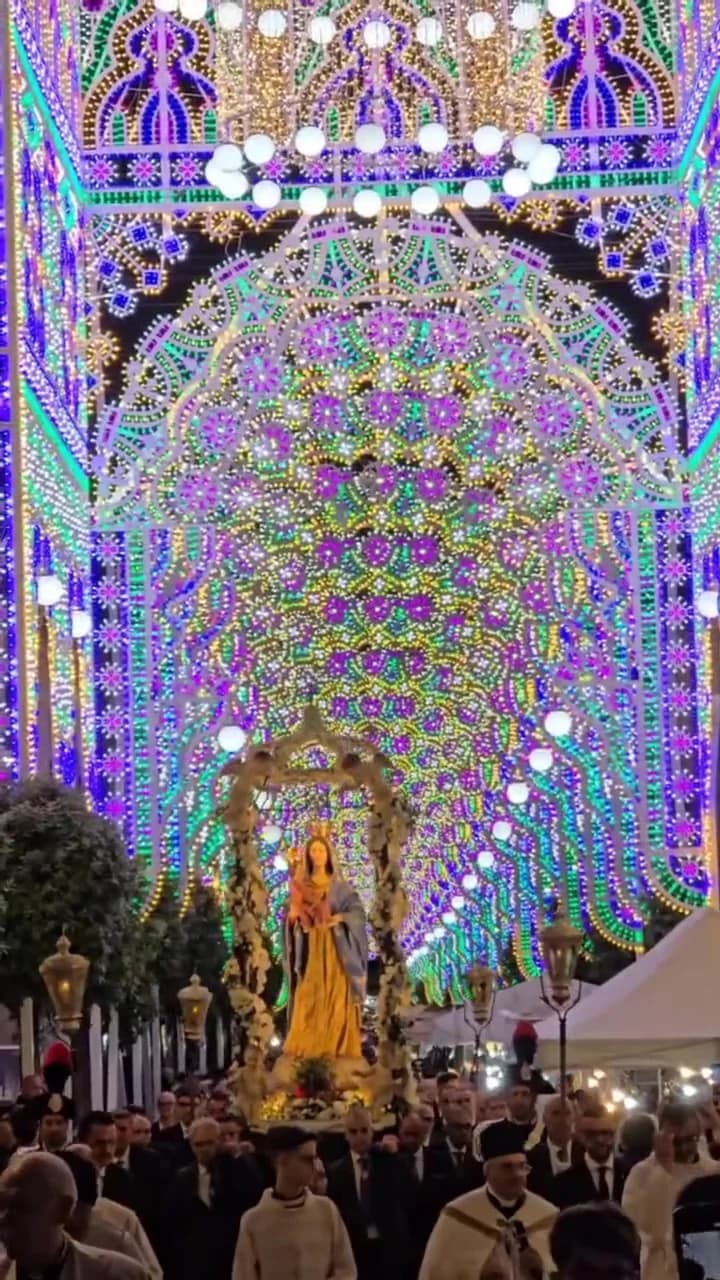
The original stone block bearing the frescoed icon of the Madonna - the very one found by the medieval farmer, according to tradition - is displayed on the high altar of the Basilica during the days of the festival. The procession of the statue winds through the streets of the historic centre on Saturday evening, between luminarie and brass bands, and returns to the basilica on Monday morning with a solemn ceremony.
The procession of the statue passes through the main luminarie portal among the faithful - Parabita, Madonna della Coltura festivities
2026 Programme: Saturday 24, Sunday 25 and Monday 26 May
The official programme is published by the Patron Saint Festival Committee in the weeks leading up to the event. What follows reflects the established structure of the celebrations in recent years, along with the variations that tradition leads us to expect each edition. For the definitive programme, it is advisable to check the Parabita municipal website and the Basilica Santuario page.
Religioso Celebrazioni liturgicheTradizione Riti folcloristiciMusica Concerti e bandePirotecnica Fuochi e spettacoli
Saturday 24 MayOpening of the festivities
Morning
Luminarie installation and decorations
The main streets and squares of the historic centre are adorned with the handcrafted luminarie. More than two kilometres of illuminated galleries with ornamental facades up to 22 metres high transform the historic centre into an architecture of light.
18:00
Preparatory triduum and Eucharistic adoration
In the Basilica Santuario, a moment of communal prayer in preparation for the patron saint solemnity.
19:30
Solemn Holy Mass
Celebration presided over by the bishop of the Diocese of Nardò-Gallipoli.
21:00
Inaugural procession of the statue
The statue of the Madonna della Coltura is carried in procession through the streets of the historic centre. Faithful who wish to carry it on their shoulders register in advance. The streets are already lit by the luminarie and lined by thousands of people.
Evening
Brass band concert and neighbourhood fireworks
The brass bands perform in the central squares. Each neighbourhood of the town organises its own fireworks display to open the festival - a long-standing competitive tradition between districts.
The illuminated galleries extend for over two kilometres along the streets of the village
A glimpse of the illuminated historic centre - the Basilica's bell tower visible in the background
Sunday 25 MayThe patron saint's day
9:00
Historical commemoration of the discovery of the Monolith
A solemn ceremony in Piazza Umberto I officially commemorating the discovery of the monolith by the medieval farmer.
10:00
Solemn pontifical Holy Mass
The main Mass of the festival, celebrated in the Basilica Santuario with the highest liturgical solemnity. The basilica fills with the faithful; those who arrive late attend from the wide external courtyard.
12:00
The curraturi - the one-kilometre race
The most eagerly awaited rite of Sunday. At the stroke of noon, the curraturi set off from contrada Paradiso and run for one kilometre along Via Coltura to "sutta a porta". Children dressed as farmers, the basket of bread, the three adult teams - and the entire street packed with a waiting crowd.
Afternoon
Fair, craft exhibitions and displays
In Piazza Cesare Terranova the Fiera della Madonna della Coltura takes place, featuring local food produce, local crafts, objects in Lecce stone and carparo limestone. Barrio Vecchio brings life to the lanes with workshops, live music, markets and street artists.
19:00
Devotional hot-air balloon competition
The pallunari - Parabita's master craftsmen of the hot-air balloon - release into the evening sky the paper balloons carrying the prayers and messages of the faithful.
21:00
Brass band concert in the square
The brass bands, arriving from across Puglia, perform in the main squares throughout the day. The evening concert in Piazza Umberto I is the most crowded musical moment.
23:00
Grand pyrotechnic fireworks display
The Sunday evening fireworks display closes the main day of celebration. From the rooftop of La Terrazza, the view is exceptional.
Monday 26 MayThe grand finale
8:30
Holy Mass and return procession
The statue of the Madonna returns solemnly to the Basilica Santuario in a morning procession. This is the liturgical farewell of the festival.
Morning
Mass dedicated to the cavamonti
A celebration dedicated to the stone quarrymen - the cavamonti - a historically fundamental figure in the economy and the building identity of the Salento.
All day
Brass band concerts and Barrio Vecchio
The bands perform in Piazza Umberto I and in the small Piazzetta degli Uffici. Barrio Vecchio brings life to the historic centre throughout the Monday afternoon as well.
22:00
Simulation of the burning bell tower
The highlight of the entire festival. The Basilica's bell tower - 42 metres tall - is engulfed in cascading pyrotechnic fire simulating a progressive inferno. The square is packed, the rooftops of the historic centre fill with spectators. When the tower appears to be completely in flames, the icon of the Madonna ascends the facade on a cord to the festive pealing of the bells.
22:30
Grand finale concert in the square
Grand finale in Piazza Umberto I with a live concert. Official close of the 2026 patron saint festivities.
How to Make the Most of It: Practical Tips
The patron saint festival of Parabita is a genuinely local event, not built for tourists. That is its greatest value - but it also means a little forethought goes a long way.
Arrive on Sunday morning early for the Solemn Mass and the commemoration of the discovery: the basilica fills quickly and the external courtyard is already full an hour before. Noon is the key moment: position yourself along Via Coltura at least 20-30 minutes beforehand to see the curraturi race in person. Monday evening is when the bell tower burns: Piazza Umberto I reaches peak capacity around 21:30 - those who arrive early find comfortable space in the square, those who arrive late make do on the steps and rooftops.
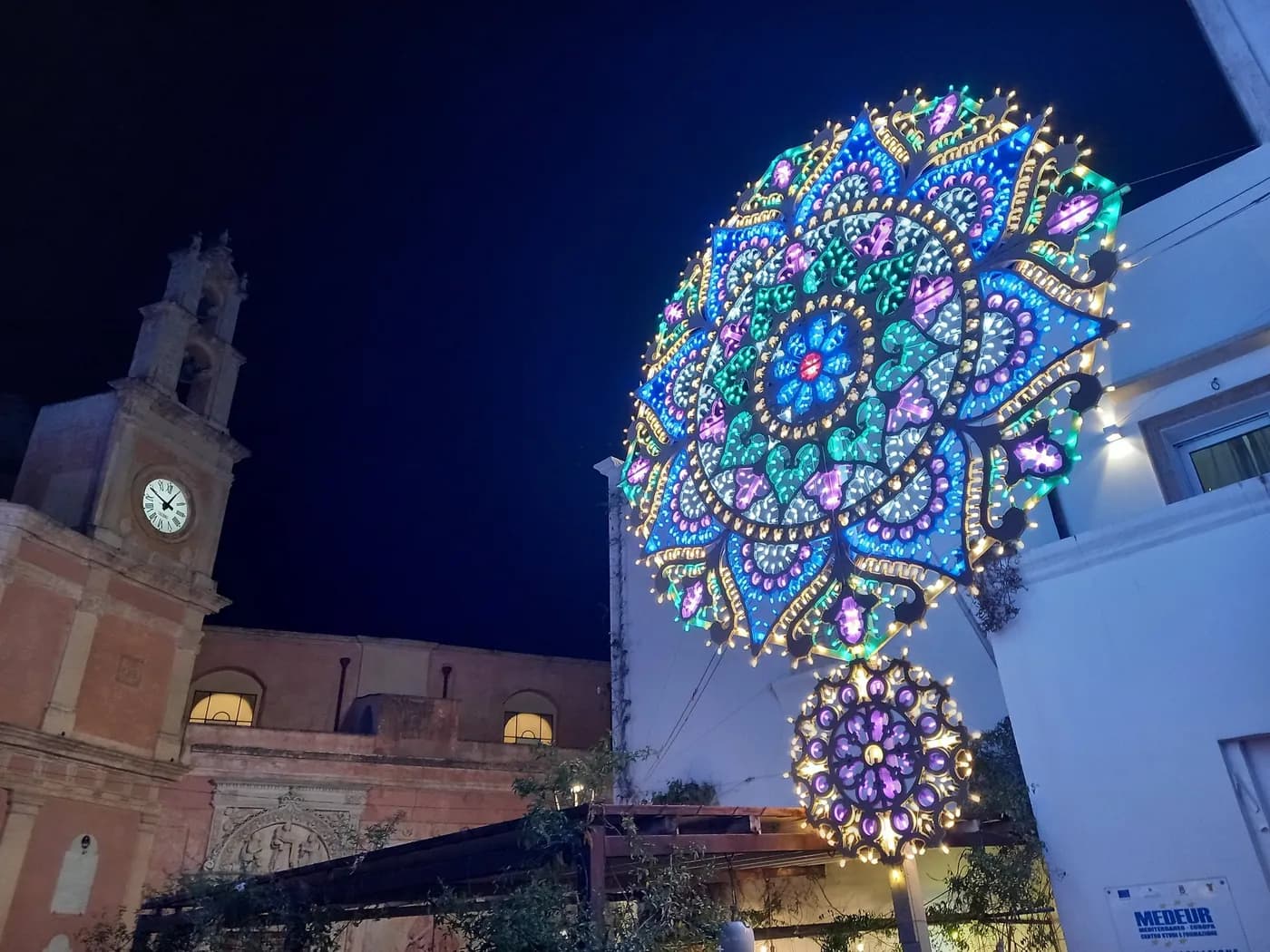
One of the great luminous rose windows above the village squares during the three days of the festival
Plan for parking: the main streets are closed to traffic during the festival days. The parking areas indicated by the municipality are at the gates of the historic centre, just a few minutes' walk from the main squares.
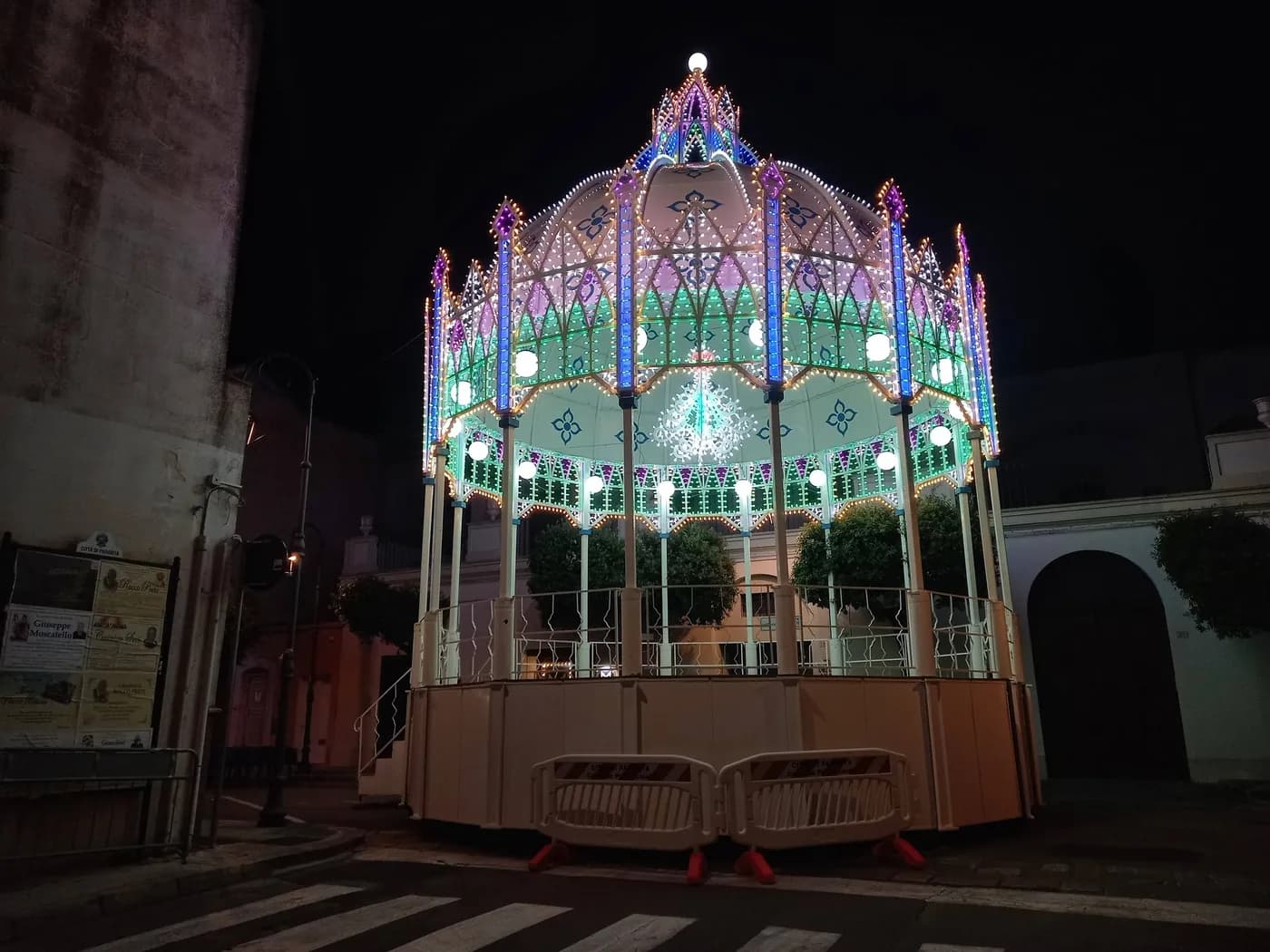
The illuminated pavilion erected in the square during the festivities - one of the most distinctive set pieces of the historic centre
Experience the festival from inside the village
Palazzetto Vico San Marco is in the heart of the historic centre. From the rooftop of La Terrazza, the fireworks can be watched from above. The 24-26 May dates book up well in advance.